
A late shipment does more damage than the calendar suggests. It stalls an assembly line. It pushes a launch date. Sometimes it ends a contract years in the making. Sourcing teams know this, which is why choosing a fabrication partner never feels like a small decision, even when the first order is.
Pen Manufacturing offers custom metal fabrication services for OEMs and industrial manufacturers across California and the wider United States, working out of an Anaheim facility set up to handle structural fabrication, precision machining, welding, and custom enclosures under one roof. Companies come to us for tight tolerances, consistent batch-to-batch parts, and lead times you can plan around.
This page walks through what custom fabrication involves, where OEM buyers get burned without a dependable partner, the materials and processes behind production, and what to check before you sign with a metal fabrication company in California.
What Are Custom Metal Fabrication Services?
Custom metal fabrication covers the engineering, cutting, forming, welding, machining, and assembly work behind turning a design into a finished metal part.
Off-the-shelf components are built to fit anyone. Custom fabrication is built to fit you. The distinction matters more than it sounds, because a part designed around your equipment, your tolerances, and your operating environment performs differently than something pulled from a catalogue.
Most jobs start the same way, with a drawing or CAD file. From there, a fabrication partner cuts raw material, forms it, welds it into an assembly, machines it to spec, and finishes it. Eight steps later, you get a component ready to install.
Industrial manufacturers, robotics companies, transportation OEMs, and electrical infrastructure providers all lean on custom fabrication for the same reason. Their parts do not exist anywhere else.
Common Challenges OEMs Face Without a Reliable Fabrication Partner
Manufacturing reliability shapes more than a single purchase order. It affects production schedules, inventory planning, and how much risk sits in your supply chain each day.
Without a dependable partner, the same problems show up again and again.
Delayed schedules: One late shipment forces every downstream plan to shift.
Long lead times: Especially from offshore suppliers, they come with almost no visibility. You are left guessing where your order stands.
Quality drifting from batch to batch: This hurts more than a late delivery for OEMs with tight specifications, because rework eats time you already budgeted elsewhere.
Capacity with no room to flex: A shop built for one volume tier forces you to run two or three suppliers to cover prototype and production, doubling your qualification work.
RFQs coming back incomplete or vague: This stalls sourcing decisions and raises the odds of an expensive mistake later.
Slow answers during production: When a fabrication partner takes days to respond to a design change, your engineering team loses it permanently.
The requalification problem: A shop strong at prototyping but weak at scale forces you to start over with a new supplier right when your program needs momentum.
None of these are edge cases. They're why OEM buyers look for one fabrication company that can carry a project from first prototype through full production, instead of handing it off twice. That’s what a custom metal fabrication company like Pen Manufacturing does: streamline operations to meet your requirements.
Why OEMs Choose Pen Manufacturing For Custom Fabrication Services
Manufacturing reliability affects more than one project. It shapes how your whole supply chain performs, which is the thing most buyers remember after the first order ships.
Customers who work with Pen Manufacturing consistently point to the same things: predictable lead times, real production capacity, tight-tolerance manufacturing, straight answers during RFQs and production, and a U.S.-based supply chain reachable by phone, not email into a void.
The numbers back it up. Projects range from $750 to $7 million. Ten or more degreed engineers work on staff. Average lead time runs around 3.2 weeks, with a 98.9% quality rating across production. The Anaheim facility has supported OEM and industrial manufacturing programs for more than 40 years.
There is no one-size-fits-all package here. A first-time prototype order and a multi-year production contract get the same level of attention, scaled to fit.
Custom Metal Fabrication Services for OEMs
Pen Manufacturing works with the full range of custom fabrication work, start to finish, for OEM programs at every stage.
Structural Metal Fabrication
The U.S. fabricated structural metal manufacturing industry was valued at $45.3 billion in 2025. Structural fabrication builds the frameworks, bases, supports, and load-bearing components holding industrial and commercial equipment together. These parts carry weight, so dimensional accuracy isn't optional.
Pen Manufacturing fabricates structural components for industrial equipment and material handling systems, holding tight tolerances on every run, not just the first.
Sheet Metal Fabrication
Sheet metal fabrication involves cutting, forming, bending, welding, and assembling sheet stock into finished parts or larger assemblies, built to the specifications an engineer hands over.
Here is what falls under this umbrella at Pen Manufacturing:
Press brake forming and bending
CNC punching and turret press work
Waterjet cutting
TIG and MIG welding, done in-house
Hardware insertion
Assembly and sub-assembly
CAD and DFM review before anything gets cut
Powder coating and anodizing
These capabilities show up in transportation parts, electronics housings, and infrastructure assemblies where precision and repeat accuracy determine whether the part works in the field.
Precision CNC Machining
Precision CNC machining uses computer-controlled tools to cut metal parts with tight tolerances, repeat geometry accurately run after run, and create shapes too complex for manual work.
Pen Manufacturing runs CNC milling, CNC turning, prototype machining, and production machining across aluminum, stainless steel, brass, bronze, and alloy steels. Whether you need five prototype units or five thousand production parts, the process scales without changing partners.
Welding and Assembly
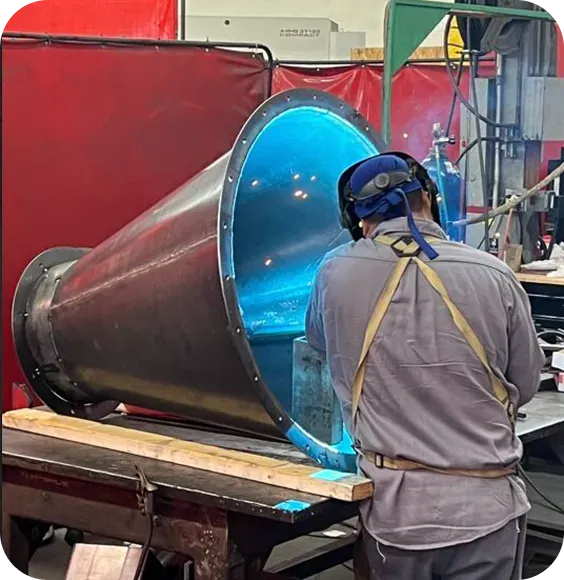
Custom welding joins cut and formed metal components into finished assemblies, enclosures, and structural parts built to a client's exact specification.
Pen Manufacturing's welding team works across TIG, MIG, aluminum, and stainless steel applications from a facility running multiple MIG and TIG stations. Process selection is not an afterthought here. The right weld affects joint strength, material performance, and how fast a job moves through the shop, so the team reviews it during engineering evaluation before a single spark flies.
Custom Metal Enclosures
Pen Manufacturing builds custom enclosures for industrial, electrical, and infrastructure applications, including:
Industrial equipment enclosures:
Electrical enclosures and control cabinets, built around access requirements varying by installation site.
Custom metal housings:
Outdoor-rated and stainless steel enclosures for equipment exposed to weather or corrosive environments.
Data and infrastructure enclosures:
We design every enclosure around environmental exposure, equipment access, and thermal load specific to where it will sit. Engineers on our team work directly with OEM engineers to confirm this before production starts, not after.
Finishing and Powder Coating
Metal finishing applies surface treatments improving corrosion resistance, durability, and readiness for compliance standards. It looks cosmetic from the outside. It is not.
A finish determines how long a part lasts and whether it holds up in the environment it was built for. Pen Manufacturing offers anodizing, powder coating, e-coating, galvanizing, bead blasting, and passivation, matching the right process to the material and application during quoting, before production begins.
What Materials Are Used in Custom Metal Fabrication?
Material choice affects strength, weight, cost, and how a part holds up over years of use. It is one of the first calls made during engineering review, because getting it wrong later means starting over.
Pen Manufacturing fabricates and machines in:
Aluminum: light and corrosion-resistant, common wherever weight reduction matters.
Stainless steel: for corrosion resistance and long service life in demanding environments.
Carbon steel: chosen for structural strength in load-bearing applications.
Brass: where machinability and corrosion resistance both need to hold up.
Bronze: for wear resistance in mechanical components under repeated friction.
Plastics: used for insulation, chemical resistance, or weight savings when metal isn't the right answer.
Getting the material right at the design stage saves rework later. Therefore, this part is not negotiable.
Industries That Rely on Custom Metal Fabrication Services
The USA’s industrial base spans aerospace, defence, energy, and advanced manufacturing, so demand for precision fabrication touches nearly every sector in the country.
Pen Manufacturing supports OEMs and industrial manufacturers working in aerospace and defence, air pollution control, electrical and electronics, entertainment, hazardous waste equipment, industrial manufacturing, lighting, material handling, medical and emergency services, oceanographic, printing, recreational, refinery and oil well equipment, robotics, scientific research, sewage treatment and disposal, specialty plastic, transportation, and wastewater treatment and disposal.
Most of these industries run on strict quality standards and long-term supply continuity, which rules out general-purpose shops without documented quality processes.
Why Metal Fabrication Matters for OEM Supply Chains
A professional metal fabrication service keeps production, inspection, and communication close enough to manage.
Plenty of OEMs are reconsidering offshore sourcing right now, and the reasons are consistent: shipping disruptions, longer lead times, little visibility into production, and quality that varies more than anyone would like to admit. A domestic partner solves each one directly.
Here is what this looks like in practice. You get closer oversight, so engineers and procurement teams check work in progress and catch problems before they become expensive. You get shorter, more predictable lead times because your parts aren't sitting on a container ship.
You get faster turnaround on design changes because your fabricator works in your time zone, not twelve hours ahead of it. And you get lower supply chain risk overall, since domestic production supports reshoring, absorbs overflow work, and strengthens succession planning for programs with no room for a gap.
Pen Manufacturing runs out of Anaheim, supporting OEMs across Orange County, Los Angeles, San Diego, and the broader Southern California region, as well as customers across the West Coast.
If you are weighing the risk of an unreliable offshore supplier against the stability of a partner down the freeway, the math usually comes down to how much disruption your business is able to absorb.
What to Look for in a Custom Metal Fabrication Company
Not every fabrication shop offers the same capability, and the cheapest quote rarely predicts the best long-term outcome.
OEM buyers tend to evaluate on the same handful of factors.
Quality consistency: Ask how the shop inspects parts, what certifications it holds, and how it documents quality across the run, not only at final inspection.
Lead time reliability: This matters more than a fast first quote. A partner who gives you a realistic number and hits it beats one that promises the moon during the sales call.
Engineering support: Look for a team reviewing your design for manufacturability before production starts, catching problems while they are still cheap to fix.
Manufacturing capability across the board: From structural fabrication to machining to finishing, without quietly outsourcing the important steps.
Scalability: A shop that supports prototyping and full production volume saves you from requalifying a new supplier the moment your program grows.
Supply chain reliability: Ask how they handle overflow work, sudden capacity crunches, and continuity if a program ramps faster than expected.
Communication: Watch how a shop handles your RFQ. It usually previews how they'll treat you once the order is placed.
A few direct questions during vetting go further than a glossy capabilities sheet. How is quality documented at each stage? What happens when a design change lands mid-run? How does the shop respond when order volume spikes without warning? The answers tell you whether a partner has real operational discipline or is only telling you what you want to hear.
Pen Manufacturing was built around these exact criteria, with degreed engineers on staff, in-house fabrication and machining capability, and documented quality controls running through every project.
The Fabrication Process From RFQ to Delivery
Most delays in custom fabrication do not happen on the shop floor. They happen in the gaps between steps, when nobody quite knows if a drawing has been reviewed, a material has been ordered, or a part is sitting in inspection. Pen Manufacturing runs a defined 8-step process on every job specifically to close those gaps.
RFQ and project review: The team reviews your drawings, specs, and quantities before quoting, so the number you receive reflects the actual job, not a guess.
Engineering evaluation: Engineers check manufacturability, tolerances, and material fit here, catching design issues while they still cost nothing to fix.
Material and production planning: We source materials and lock in the production approach before a single part touches the floor.
Prototype or production setup: Equipment and tooling get configured for your specific job, whether that is a 5-piece prototype run or a 5,000-unit production order.
Fabrication and machining: This is where parts get cut, formed, welded, and machined to spec. It is also the longest stage, and the one most affected by everything decided in the first three steps.
Inspection and quality checks: Checks happen at defined points through the run, not only at final sign-off, so a problem gets caught in hour ten instead of day ten.
Assembly and finishing: Parts come together and get finished according to your requirements, whether that means powder coat, anodizing, or another process entirely.
Delivery coordination: Delivery gets timed to your schedule, not the shop's convenience.
Two things make this sequence worth more than it looks like on paper.
First, nothing moves to the next stage without a checkpoint, so problems get caught close to where they started instead of showing up at final inspection.
Second, you get visibility at every step instead of a black box between quote and delivery truck.
For a schedule-sensitive OEM program, that kind of visibility is worth more than a slightly lower price. A cheaper quote does not help much if you find out in week five that the job never left engineering review.
One Manufacturing Partner for Complex OEM Projects
Most OEM projects need more than one process to reach a finished part. A structural frame might need welding, machining, and a powder coat finish before it ships. Split those three steps across three vendors, and you are now managing three schedules and three quality standards for one component.
Pen Manufacturing keeps welding, sheet metal fabrication, precision machining, powder coating, and assembly under one roof in Anaheim. One team takes the part from raw material to finished assembly, cutting handoffs and giving you one point of contact for the whole build instead of three.
Ten or more degreed engineers back this up, reviewing manufacturability and troubleshooting problems before they reach the shop floor. It also means a part moves from prototype to full production run without changing facilities or requalifying a new supplier partway through.
If your team is dealing with reshoring, overflow work from an existing supplier, or succession planning for a supply chain with no room for a gap, having one partner absorb all three simplifies things more than it sounds on paper.
Quality and Certifications
Quality is not one inspection at the end of a job. It runs through every stage, or it does not mean much.
Pen Manufacturing holds AS9100D and ISO 9001 certifications, plus NADCAP accreditation for welding, which supports supplier qualification for aerospace, defense, and other regulated programs.
Here is the actual process behind those certifications, in four stages.
Front-end engineering preparation: where engineers pull critical dimensions and define quality metrics using 3D modeling before anything gets cut.
Certified fabrication: run to AS9100 and ISO 9001 standards.
In-process inspection: with verified checks built into each stage rather than saved for the end. And end-of-cycle verification, using Keyence CMM equipment and calibrated metrology on every product.
A certification alone does not guarantee a good experience. What it does guarantee is a documented, traceable process, which matters a lot more once something needs to be reproduced exactly the same way a year later.
Ready to Discuss Your Custom Metal Fabrication Requirements?
A slipped schedule or a late shipment never costs only the one order. It touches customer commitments, inventory planning, and how much your supply chain is trusted going forward.
Waiting until a supplier fails before looking for a backup rarely goes well. Most OEMs make the call under pressure, with far less room to evaluate anyone.
Pen Manufacturing works with OEM procurement teams and engineers who need a dependable fabrication partner for structural work, sheet metal, precision machining, welding, and custom enclosures. Send over your drawings and your timeline, and the team will walk you through what a U.S.-based manufacturing partner looks like for your supply chain.
Contact Pen Manufacturing to talk through your RFQ, production requirements, or long-term manufacturing plans.