
If you've ever tried to source a metal component for a new product, an equipment upgrade, or a large-scale production run, you already know the process is rarely simple. Between choosing the right manufacturing method, finding a shop that can meet tight tolerances, and ensuring the finished part survives years of real-world use, a lot is riding on who you partner with.
At Pen Manufacturing, we've spent more than 40 years supporting OEMs and industrial companies throughout Anaheim, Orange County, Los Angeles, and the rest of Southern California with precision metal fabrication, CNC machining, welding, and finishing services. This guide breaks down everything OEMs, engineers, and procurement teams need to understand about precision manufacturing, from metal fabrication and contract manufacturing to CNC precision machining, plating, deburring, and quality control, so you can ask better questions, avoid costly mistakes, and choose a manufacturing partner built for the long haul.
What Should OEMs Look for in a Metal Fabrication Partner?
Modern OEMs benefit from working with a manufacturing partner that can manage metal fabrication, machining, welding, finishing, and quality control under one roof. Consolidating these capabilities helps reduce supplier coordination, improve production consistency, and strengthen supply chain resilience.
When evaluating a partner, look beyond pricing. Engineering support, certifications, production capacity, quality systems, and dependable lead times all contribute to long-term manufacturing success.
Key Takeaway: OEMs can strengthen supply chain resilience by partnering with a manufacturer that integrates metal fabrication, machining, welding, finishing, and quality control into a single, streamlined production workflow.
Understanding Contract Manufacturing Services
Contract manufacturing is the practice of outsourcing production, fabrication, machining, or assembly work to a third-party manufacturer rather than building and staffing those capabilities in-house. For OEMs and industrial companies, this isn't just a cost-saving tactic. It's a strategic decision that affects product quality, delivery timelines, and long-term supply chain resilience.
As a contract manufacturing company serving OEMs since 1982, we act as an extension of our customers' engineering and operations teams. Instead of managing multiple vendors for welding, sheet metal, machining, and finishing, our customers work with one accountable partner who can handle the entire scope under one roof, reducing instances where quality or communication breaks down.
What Contract Manufacturing Actually Involves
Contract manufacturing services typically span the full production lifecycle: reviewing a quote request (RFQ), evaluating engineering drawings, sourcing raw materials, machining or fabricating components, applying finishes or coatings, performing inspections, and coordinating final assembly and delivery. A strong contract manufacturer doesn't just execute a print. They also flag manufacturability issues early, recommend material or design changes that reduce cost, and plan production schedules that align with your delivery commitments.
Benefits of Contract Manufacturing Services
The benefits of contract manufacturing services go well beyond simply freeing up floor space.
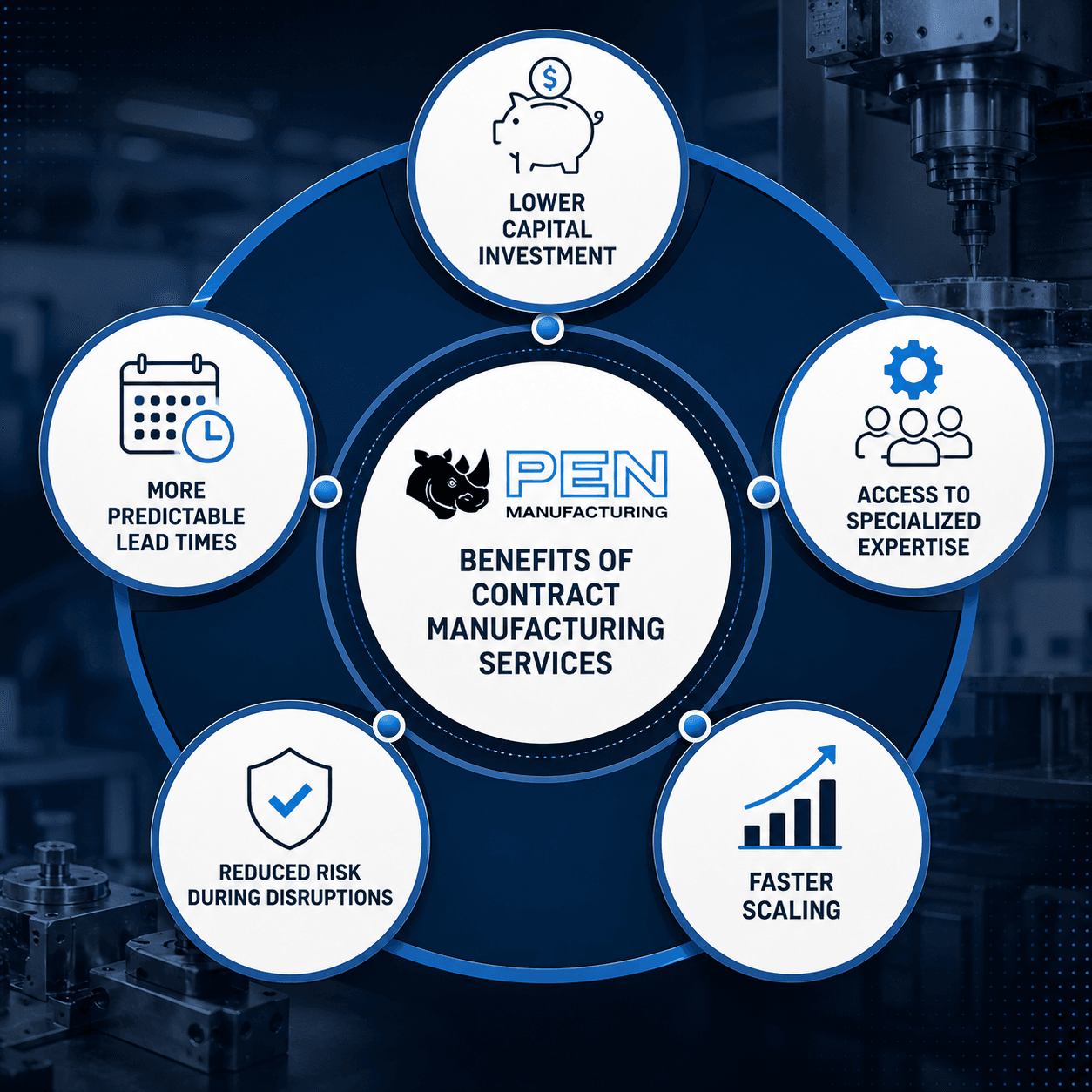
Companies that outsource production strategically often see:
- Lower capital investment, since there's no need to purchase and maintain expensive CNC equipment, welding infrastructure, or finishing lines
- Access to specialized expertise, including degreed engineers, without adding permanent headcount
- Faster scaling from prototype to full production runs
- Reduced risk during supply chain disruptions, since an experienced partner can absorb overflow work or unexpected volume
- More predictable lead times, since production planning is handled by a team that does this daily
Our own customers see the tangible benefits firsthand. Pen Manufacturing supports order sizes ranging from $750 to $7 million, with an average lead time of just 3.2 weeks and a 98.9% quality rating, giving OEMs a level of predictability that's hard to build in-house.
Contract Manufacturing vs. In-House Production
Many OEMs eventually face the "make vs. buy" decision as demand grows. Building in-house capability means investing in equipment, hiring and training skilled machinists and welders, and absorbing the overhead of running a manufacturing operation, even during slow periods. Contract manufacturing shifts that overhead to a partner who already has the equipment, trained staff, and process controls in place, letting your team focus on product development, sales, and customer relationships instead of shop floor management.
This doesn't mean in-house production is never the right call. Companies with highly proprietary processes or extremely high, stable volumes sometimes find in-house manufacturing more economical over time. But for most OEMs facing variable demand, evolving designs, or multiple product lines, a contract manufacturing partner offers greater flexibility with lower financial risk.
When Contract Manufacturing Makes the Most Sense
Contract manufacturing is especially valuable for companies navigating reshoring efforts, managing overflow work during peak demand, or building succession planning into their supply chain. If your internal capacity is stretched thin, or if a current supplier's lead times and quality have become unpredictable, bringing in a partner like Pen Manufacturing can stabilize production without requiring a complete overhaul of your operations.
Thinking about outsourcing part or all of your production? Get a quote from our team and let's discuss your project requirements.
How Metal Fabrication Strengthens Supply Chains for OEMs
Metal fabrication strengthens OEM supply chains by reducing vendor handoffs, improving production flexibility, and allowing multiple manufacturing processes to be managed by one qualified manufacturing partner. Integrated fabrication combines cutting, forming, welding, machining, finishing, and assembly to simplify production while helping manufacturers respond more effectively to changing demand.
Supply chain disruptions often stem from fragmented production, limited supplier capacity, or communication gaps between multiple vendors. Working with an integrated metal fabrication partner helps reduce these risks by improving coordination, maintaining production continuity, and supporting long-term manufacturing goals.
For OEMs managing complex supply chains, that resilience isn't optional. It's a core part of our metal fabrication services at our Anaheim facility.
How Single-Source Dependence Puts OEM Supply Chains at Risk
When a single fabricator or supplier is responsible for a critical component, any disruption on their end, whether a staffing shortage, equipment failure, or capacity constraint, becomes your disruption too. Spreading fabrication work across multiple disconnected vendors doesn't necessarily solve this either, since it introduces more handoffs, more opportunities for miscommunication, and more points where a delay can compound. A fabrication partner with broad in-house capabilities reduces the number of places where a single failure can stall your production.
Consolidating Fabrication Capabilities Reduces Vendor Handoffs
Every additional vendor in a supply chain is another lead time to track, another quality standard to reconcile, and another relationship that can break down under pressure. When cutting, forming, welding, and assembly are handled under one roof, OEMs eliminate several handoff points. Fewer vendors also means fewer places where a dimensional issue or a miscommunication can get lost between one shop and the next.
How Fabrication Capacity Absorbs Demand Spikes and Disruptions
A resilient supply chain needs more than one reliable process. It needs capacity that can flex when circumstances change. Integrated metal fabrication gives OEMs greater production flexibility because fabrication, machining, welding, and finishing can be coordinated through a single manufacturing partner instead of multiple independent suppliers. Metal fabrication supports OEM supply chains in several concrete ways:
- Absorbing overflow work: a fabrication partner with spare capacity can take on unexpected volume when an existing supplier falls behind, without forcing a full requalification process
- Supporting reshoring: domestic fabrication capacity gives OEMs a way to shorten lead times and reduce exposure to overseas shipping disruptions
- Reducing single points of failure: qualifying a fabrication partner with broad capabilities in advance means production can shift quickly if a current supplier's lead times or quality become unpredictable
- Supporting succession planning: a partner who can step in for aging or at-risk suppliers helps OEMs avoid being caught without a qualified source mid-program
Why Reshoring and Domestic Fabrication Capacity Matter
Offshore sourcing has become considerably less predictable in recent years, with shipping disruptions, longer lead times, and limited visibility into production status pushing many OEMs to reconsider where their metal components are made. Domestic fabrication capacity, such as our Anaheim facility, gives OEMs a way to shorten the distance between a design change and a finished part, respond faster when specifications shift, and reduce exposure to disruptions associated with long, multi-country supply chains.
Choosing a Fabrication Partner Built for Long-Term Supply Chain Stability
Not every fabrication shop is set up to function as a supply chain safety net. Some operate near full capacity with little room to absorb overflow work, while others lack the certifications, engineering support, or documentation practices that regulated industries require. Pen Manufacturing holds AS9100D, ISO 9001, NADCAP, and ITAR compliance specifically to provide OEMs with documented, auditable evidence that our processes can support their programs, even under pressure. When evaluating a fabrication partner for supply chain resilience, ask about spare capacity, average lead times, and how quickly they can onboard a new program if a current supplier falls through.
Materials That Support Flexible, Resilient Fabrication
Fabrication flexibility also depends on material sourcing. Our team fabricates a wide range of metals, including aluminum, stainless steel, carbon steel, brass, and bronze, as well as select engineering plastics, which means OEMs aren't limited to whatever a single material specialist happens to stock. Being able to source, fabricate, and finish multiple material types under one roof reduces the number of separate vendor relationships needed to keep a production program running.
Worried about single-source risk or a supply chain that can't flex when demand shifts? Get a quote from our team and let's talk about building more resilience into your production.
Metal Fabrication Process Overview
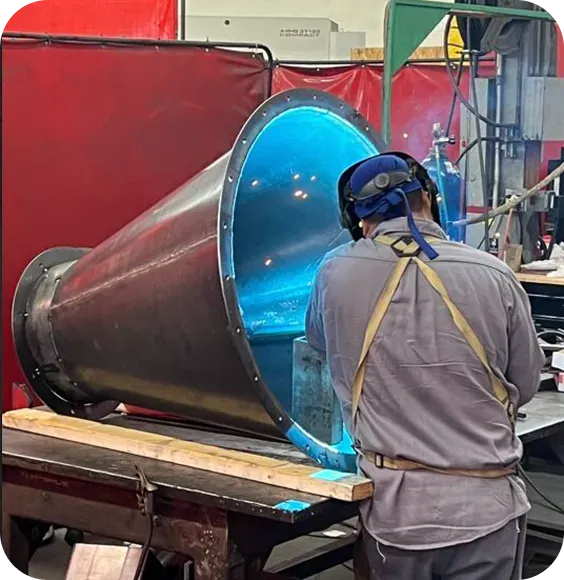
While CNC machining removes material to create a part, metal fabrication is a broader term that encompasses the full range of processes used to cut, bend, form, join, and assemble metal into finished structures or components. Metal fabrication services are essential for everything from structural brackets and enclosures to complex welded assemblies used in industrial equipment, and they're one of the core capabilities we've built our business around since 1982.
Core Steps in the Metal Fabrication Process
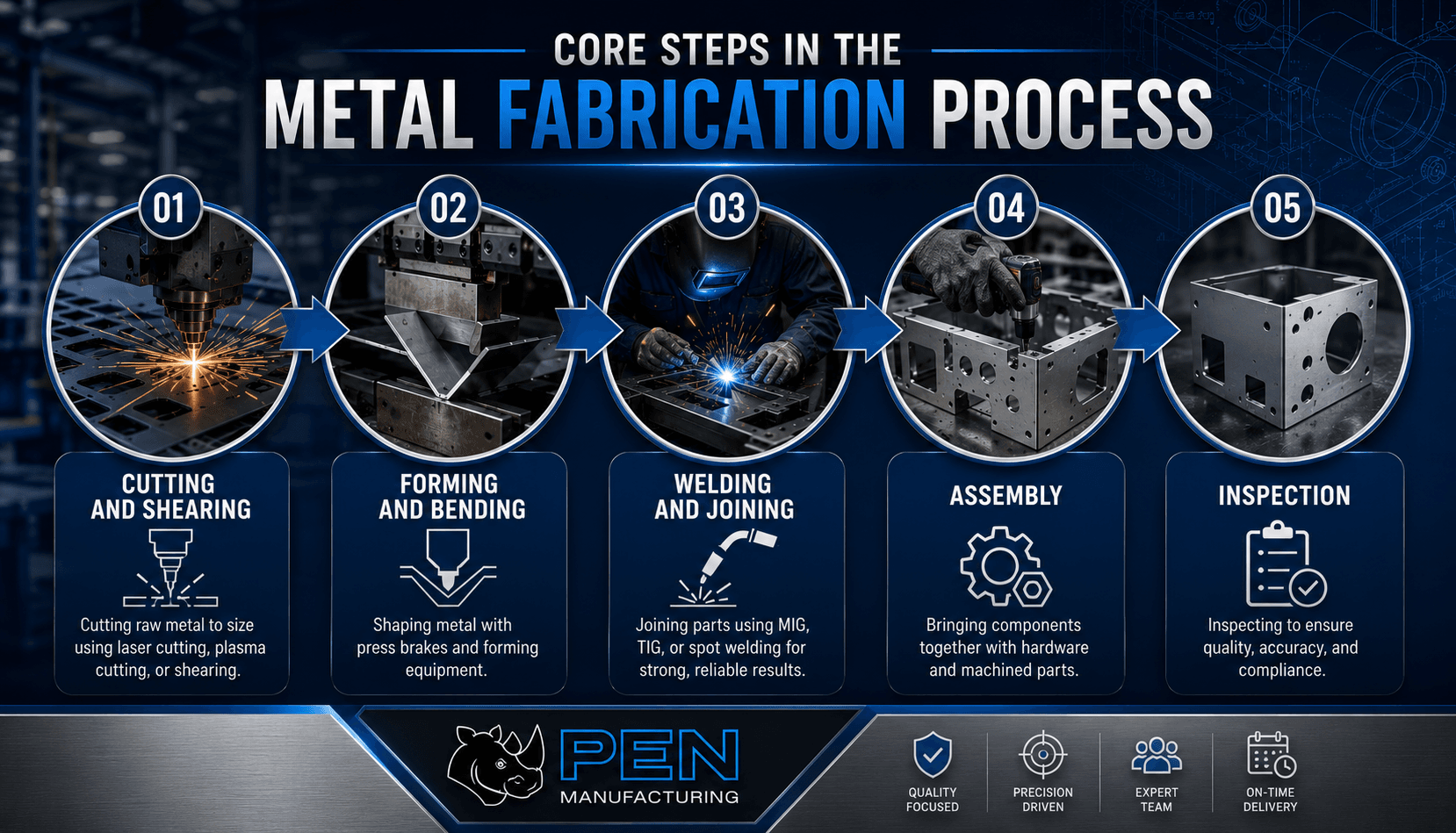
A typical metal fabrication process moves through several distinct stages:
Cutting and Shearing
Raw sheet metal or plate stock is cut to size using methods like laser cutting, plasma cutting, or mechanical shearing. Laser cutting, in particular, has become a standard for its precision and ability to handle intricate geometries without introducing significant material distortion.
Forming and Bending
Once cut, sheet metal is formed into its intended shape using press brakes and other forming equipment. This step transforms flat stock into three-dimensional parts like enclosures, brackets, and housings, and it requires careful attention to bend allowances and grain direction to avoid cracking or warping.
Welding and Joining
Multiple pieces are joined using welding processes such as MIG, TIG, or spot welding, depending on material thickness, joint design, and required strength. Certified welding is especially critical for structural or safety-relevant assemblies, where weld quality directly affects performance and compliance with industry standards, including the NADCAP requirements many of our aerospace customers require. Read more on how custom welding and precision metal fabrication keep OEM production lines running smoothly.
Assembly
Fabricated components are brought together into a finished assembly, sometimes incorporating hardware, fasteners, or other manufactured parts produced through additional processes such as CNC machining. Our finishing and assembling team manages this stage to ensure the finished product meets the original engineering intent.
Here’s a detailed breakdown of why engineers prioritize surface services for CNC metal alloys for precision finishing and durability.
Custom Metal Fabrication vs. Standard Fabrication
Custom metal fabrication is built around a specific engineering drawing or design rather than a stock product, which means every step, from material selection to final assembly, is tailored to the application. This is common across the aerospace, medical device, and industrial equipment programs we support, where off-the-shelf components rarely meet the exact requirements of a specialized system.
Common Applications of Metal Fabrication Services
Metal fabrication services support an enormous range of end products, including industrial equipment enclosures, electrical control cabinets, structural supports, custom metal housings, and outdoor-rated or stainless steel enclosures designed for harsh environments. As a trusted custom enclosure manufacturer, we work closely with OEMs and engineers across Southern California to make sure each fabricated component aligns with environmental exposure, equipment access, and installation requirements specific to their application.
Working on a fabrication project with tight deadlines or complex geometry? Reach out to our team about your drawings and timeline.
Metal Plating and Surface Finishing Guide
A precision-machined or fabricated part isn't truly finished until it has the right surface treatment. Metal plating and surface finishing protect components from corrosion, wear, and environmental exposure while also improving appearance, conductivity, or paint adhesion depending on the application. Skipping or under-specifying this step is one of the most common and costly mistakes we see OEMs make when working with a new supplier for the first time.
Why Metal Plating Is Important in Manufacturing
Why metal plating is important in manufacturing comes down to protection and performance. Bare metal is vulnerable to oxidation, rust, and chemical degradation, especially in outdoor, marine, or industrial environments common across Southern California's energy, wastewater, and industrial sectors. Plating and coatings create a barrier between the base metal and the elements, significantly extending the service life of a component. In some applications, plating also improves electrical conductivity, reduces friction between moving parts, or provides a consistent surface for subsequent painting or bonding.
Different Types of Metal Plating Processes
There isn't a single "best" plating process. The right choice depends on the base material, the operating environment, and the part's functional requirements. Some of the most common types of metal plating processes include:
- Zinc plating: a cost-effective option that provides solid corrosion resistance for steel components, commonly used in general industrial applications
- Nickel plating: offers excellent corrosion and wear resistance along with a durable, attractive finish, often used in components exposed to friction or moisture
- Chrome plating: provides a hard, wear-resistant surface with strong corrosion resistance, frequently chosen for parts requiring both durability and appearance
- Anodizing: technically an electrochemical conversion process rather than plating, anodizing is widely used on aluminum to increase corrosion resistance and surface hardness
- Powder coating: a durable, high-performance finish applied as a dry powder and cured under heat, offering excellent resistance to chipping, scratching, and fading compared to traditional liquid paint
Metal Coating Services Beyond Plating
Our powder coating services provide a durable, high-performance finish that protects and enhances the metal components we produce for customers across aerospace, industrial, and infrastructure applications. Choosing the right finish often requires balancing cost, appearance, durability, and the environment in which the part will ultimately operate, and our team works through those trade-offs with customers during the engineering evaluation stage.
Matching the Right Finish to Your Application
An experienced manufacturing partner will help you evaluate trade-offs between finish types based on your part's end use. A control cabinet installed outdoors in a coastal environment, for instance, has very different finishing requirements than an indoor bracket in a climate-controlled facility. Getting this decision right the first time avoids premature failure, warranty issues, and costly rework down the line.
Not sure which plating or coating is right for your application? Contact our team, and we'll help match the right finish to your part's environment and performance needs.
Why Deburring Is Critical in Manufacturing
It's easy to overlook deburring when you're focused on tolerances, materials, and finishes, but skipping this step can undermine everything else in the manufacturing process. Deburring is the process of removing sharp edges, burrs, and small imperfections left behind after cutting, machining, drilling, or stamping operations.
What Causes Burrs During Manufacturing
Burrs form naturally whenever a cutting tool shears through metal, whether that's during CNC machining, laser cutting, drilling, or stamping. The material displaced at the edge of a cut doesn't simply disappear. It curls or folds into a small raised ridge along the part's edge. The severity of burring depends on the material, tool condition, cutting speed, and the specific process used.
Why Deburring Is Critical in Manufacturing Outcomes
Why deburring is critical in manufacturing becomes obvious once you consider what happens downstream if it's skipped. Sharp burrs can interfere with proper fit and assembly, damage mating components, create safety hazards for anyone handling the part, and even compromise the effectiveness of plating or coating applied afterward, since coatings don't adhere evenly over sharp, irregular edges. In precision assemblies, an unaddressed burr can prevent two parts from seating correctly, leading to failed inspections or field returns, which is exactly the kind of quality issue our AS9100D processes are designed to catch before it happens.
Common Deburring Methods
Manufacturers use several deburring approaches depending on part geometry, material, and production volume:
- Manual deburring: using hand tools or abrasive pads, typically reserved for low-volume or complex geometries
- Tumbling and vibratory finishing: parts are placed in a machine with abrasive media that smooths edges through controlled agitation
- Thermal deburring: a controlled combustion process that removes burrs from hard-to-reach internal passages
- Automated CNC deburring: programmed tool paths remove burrs as part of the machining cycle itself, improving consistency and reducing labor
Building Deburring Into the Manufacturing Process
The most reliable manufacturers don't treat deburring as an afterthought. They build it into the production workflow from the start, with clear specifications for edge conditions included on engineering drawings. This is exactly how our team approaches every job, ensuring every part meets the same standard rather than relying on inconsistent manual touch-up at the end of the line.
Concerned about edge quality or fit-up issues on your components? Talk to our team about how we handle deburring and edge finishing on every job.
How to Choose a Long-Term Manufacturing Partner
Sourcing a manufacturer for a single prototype run is a very different exercise than choosing a partner you'll rely on for years of ongoing production. Long-term manufacturing relationships affect everything from product quality and cost stability to your company's ability to respond quickly when specifications, volumes, or timelines change.
How to Choose a Long-Term Metal Fabrication Partner
Choosing a long-term metal fabrication partner starts with looking beyond price quotes and evaluating operational fundamentals.
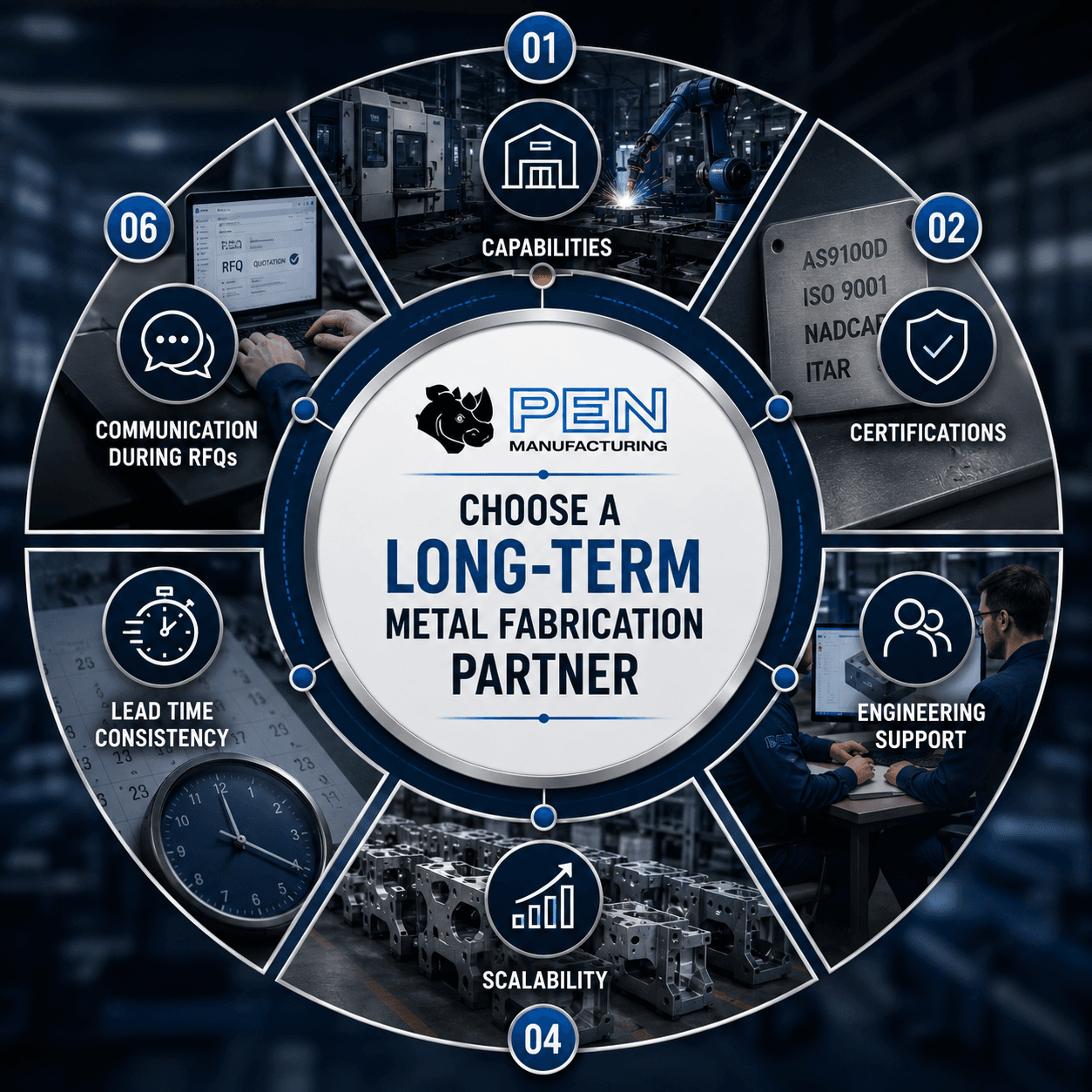
Consider factors like:
- Capabilities under one roof: a partner offering welding, machining, sheet metal fabrication, and finishing together reduces the number of vendors you need to coordinate and minimizes handoff errors
- Certifications and compliance: depending on your industry, certifications like AS9100D, ISO 9001, NADCAP, or ITAR registration may be non-negotiable requirements.
- Engineering support: partners with degreed engineers on staff can catch manufacturability issues before they become expensive problems
- Production scalability: Can the shop handle a single prototype today and a full production run six months from now without a drop in quality or communication?
- Lead time consistency: ask for real data on average lead times and on-time delivery performance, not just promises
- Communication during RFQs: how quickly and thoroughly a shop responds during quoting often predicts how they'll communicate during a live production issue
Pen Manufacturing was built around these exact fundamentals. We maintain AS9100D, ISO 9001, NADCAP, and ITAR compliance, employ degreed engineers on staff, and offer welding, sheet metal, machining, powder coating, and finishing under one roof at our Anaheim facility, backed by a 3.2-week average lead time and a 98.9% quality rating.
Red Flags to Watch For
Be cautious of manufacturers who are vague about certifications, unwilling to share references, or evasive about lead times and capacity. Inconsistent communication during the RFQ process often foreshadows what to expect once a purchase order is placed.
Building a True Partnership, Not Just a Vendor Relationship
The strongest manufacturing relationships function more like partnerships than transactional vendor arrangements. A long-term partner should proactively communicate about material cost changes, capacity constraints, or design improvements, rather than waiting for you to ask. They should also be positioned to support succession planning within your supply chain, so a single point of failure doesn't put your production at risk, which is a large part of how we work with OEM customers who are reshoring production or reducing reliance on offshore suppliers.
Looking for a manufacturing partner you can rely on for years, not just one project? Get in touch and let's start a conversation about your production goals.
Quality Control in Precision Manufacturing
Precision manufacturing is defined by its quality control processes. A part that looks correct but falls outside tolerance, or that passes a visual check but fails under load, can create expensive problems well after it leaves the shop floor. Robust quality control isn't a final checkpoint. It's a system built into every stage of production, and it's the foundation of our quality program at Pen Manufacturing.
Key Elements of a Strong Quality Control Program
Effective quality control in precision manufacturing typically includes:
Incoming Material Inspection
Verifying that raw materials meet specified grades, certifications, and dimensional requirements before they ever reach a machine or fabrication station. Using the wrong alloy or an out-of-spec material can compromise an entire production run.
In-Process Inspection
Checking dimensions, weld quality, and surface conditions at multiple stages during production rather than waiting until the part is complete. Catching a deviation early prevents wasted material and rework further down the line.
Final Inspection and Documentation
Comprehensive final checks, often supported by coordinate measuring machines (CMMs) and other precision measurement tools, confirm the finished part meets every dimension and specification on the drawing. Documented inspection reports provide traceability, which is essential in regulated industries such as aerospace and medical devices.
Certifications That Signal Quality Commitment
Certifications like AS9100D (the aerospace quality management standard), ISO 9001, NADCAP, and ITAR registration aren't just paperwork. They reflect a manufacturer's commitment to documented, auditable, repeatable processes. Pen Manufacturing holds all four, which is why OEMs in aerospace, defense, and medical device manufacturing trust us with their most demanding programs. When evaluating a potential partner, ask specifically which certifications they hold and how recently they were audited.
Building a Culture of Quality, Not Just a Checklist
The most effective quality control programs treat inspection as a mindset shared across the shop floor, not a single department's responsibility. Our machinists, welders, and finishing technicians understand tolerance requirements and quality expectations at each step, which is a large part of how we've maintained a 98.9% quality rating across our production history.
Why Quality Control Protects More Than the Part
Strong quality control protects your production schedule as much as it protects the physical part. Catching a dimensional issue in-house before a component ships avoids the far more expensive scenario of a failed part being discovered during your own assembly process, or worse, in the field.
Want to see how quality control is built into our production process? Reach out, and we'll walk you through our inspection standards.
Industries That Benefit from Precision Metal Manufacturing
Precision metal manufacturing supports an unusually wide range of industries, largely because nearly every physical product or piece of equipment relies on custom metal components at some point in its construction. Pen Manufacturing has supported a broad mix of industries throughout Southern California for more than four decades, which gives us insight into what different sectors typically look for in a manufacturing partner.
Aerospace and Defense
Aerospace and defense applications demand some of the tightest tolerances and most rigorous documentation requirements in manufacturing, often requiring AS9100D certification and full material traceability from raw stock to finished part. This is one of our core markets, supported by our AS9100D, NADCAP, and ITAR compliance.
Medical and Emergency Services
Medical and emergency services components require exceptional standards of consistency and cleanliness, since even small dimensional variances can affect the safety and functionality of critical equipment.
Electrical and Electronics
Electrical and electronics, control cabinets, and component housings need precise fit and, in many cases, specific finishes to support conductivity, grounding, or environmental sealing requirements.
Industrial and Material Handling
Industrial equipment manufacturers and material handling companies rely on durable fabricated assemblies and machined components that can withstand continuous operation, heavy loads, and demanding environments.
Wastewater, Sewage, and Hazardous Waste Equipment
Components used in wastewater treatment and disposal, sewage disposal, and hazardous waste equipment often require corrosion-resistant materials and coatings that withstand constant exposure to chemicals and moisture.
Additional Industries Relying on Precision Manufacturing
Beyond these core sectors, we also support oceanographic research, scientific research equipment, robotics, transportation, lighting, printing, entertainment, and refinery and oil-well equipment, a testament to how foundational metal fabrication and machining are in nearly every corner of industrial production.
What These Industries Have in Common
Despite their differences, industries that rely on precision metal manufacturing tend to share a few common threads: strict quality expectations, a need for consistent repeatability across production runs, and components that must perform reliably in demanding or unforgiving environments. Whether it's a bracket inside a piece of scientific research equipment or a housing exposed to constant moisture in a wastewater facility, the underlying requirement is the same: a manufacturing partner capable of delivering the right material, tolerance, and finish, every single time.
Curious how precision manufacturing applies to your specific industry? Get in touch, and we'll discuss your project's unique requirements.
End-to-End Manufacturing Workflow
One of the biggest advantages of working with a full-service contract manufacturer is the ability to move a project through a structured, predictable workflow from initial quote to final delivery, without juggling multiple disconnected vendors along the way. This is the same eight-step process our team follows on every OEM program we support.
Step 1: RFQ and Project Review
The process begins with a detailed review of your request for quote, including drawings, specifications, quantities, and timeline requirements. This is also the stage where manufacturability concerns should surface early, before any material is cut.
Step 2: Engineering Evaluation
Our degreed engineers assess the design for feasibility, tolerance requirements, and potential cost or performance improvements, often collaborating directly with your team to refine the approach.
Step 3: Material and Production Planning
Material selection, sourcing, and production scheduling are finalized based on the part's requirements and your delivery timeline.
Step 4: Prototype or Production Setup
Depending on the project stage, tooling and machine setups are configured for either a prototype run to validate design or a full production run optimized for volume and consistency.
Step 5: Fabrication and Machining
Parts move through the appropriate combination of CNC machining, welding, cutting, forming, and assembly processes based on the component's design.
Step 6: Inspection and Quality Checks
Parts are inspected against drawing specifications using appropriate measurement tools, with documentation generated to support traceability requirements under our AS9100D quality system.
Step 7: Assembly and Finishing
Components move into final assembly along with any required plating, coating, or surface finishing processes, including our in-house powder coating.
Step 8: Delivery Coordination
Finished parts are packaged and coordinated for delivery in alignment with your production schedule, minimizing downtime on your end.
Why a Structured Workflow Matters
A clearly defined workflow improves visibility at every stage of production, making it far easier to catch issues early, communicate proactively, and consistently meet delivery deadlines, all of which matter enormously when a delayed component can stall an entire assembly line.
Ready to move your project through a proven manufacturing workflow? Submit your RFQ and let's get started.
Common Challenges in Metal Component Production
Even with a strong manufacturing partner, metal component production comes with real challenges that OEMs and procurement teams need to plan for. Understanding these challenges upfront makes it easier to avoid delays and unexpected costs, and it's exactly what our team helps customers navigate every day.
Delayed Production Schedules
Production delays often stem from unclear specifications, late design changes, or material availability issues. Clear communication and thorough upfront engineering review significantly reduce this risk.
Long Supplier Lead Times
Offshore sourcing, in particular, has become less predictable in recent years due to shipping disruptions and limited production visibility, pushing many OEMs toward U.S.-based, reshored manufacturing options to gain greater control over timelines. Our Anaheim facility exists specifically to give OEMs a domestic alternative.
Inconsistent Manufacturing Quality
Variability between production runs, or even within a single run, usually points to gaps in process documentation or inspection procedures. This is why standardized quality control processes matter so much for repeat production.
Capacity Limitations
A manufacturer operating at or near full capacity may struggle to absorb overflow work or unexpected increases in volume, putting your production schedule at risk during periods of growth. Supporting overflow work and reducing supply chain risk are among the reasons OEMs bring Pen Manufacturing into their supplier base, even when they already have an existing production partner.
Complex RFQ Requirements
Detailed technical requirements, tight tolerances, and specialized certifications can make the quoting process slower and more complex, especially with manufacturers unfamiliar with your industry's specific standards.
Scaling from Prototype to Production
Many manufacturers can produce a single prototype successfully but struggle to replicate that same quality and consistency at production volume. Evaluating a partner's production scalability during the prototype phase can prevent painful surprises later.
Communication Gaps During Production
Miscommunication among engineering, procurement, and the shop floor is one of the most common and most avoidable sources of manufacturing delays and quality issues. Partners who provide proactive updates throughout production, rather than only responding when asked, tend to prevent small issues from becoming large ones.
Facing one of these challenges with a current supplier? Let's talk about how we can help stabilize your production and reduce risk.
Final Thoughts
Precision metal manufacturing supports industries ranging from aerospace and medical devices to industrial equipment and infrastructure. Whether you're evaluating contract manufacturing, expanding your metal fabrication capabilities, or strengthening your supply chain with an integrated manufacturing partner, the principles covered in this guide can help you make more informed sourcing decisions throughout the production lifecycle.
The right manufacturing partner does more than execute a print. They bring engineering insight, consistent quality control, and dependable production planning to every project, protecting your timeline, your budget, and your reputation with your own customers. For more than 40 years, that's exactly the role Pen Manufacturing has played for OEMs across Anaheim, Orange County, Los Angeles, and Southern California.
Ready to discuss your next manufacturing project? Contact our team to talk through your requirements, or request a quote to get the process started.