

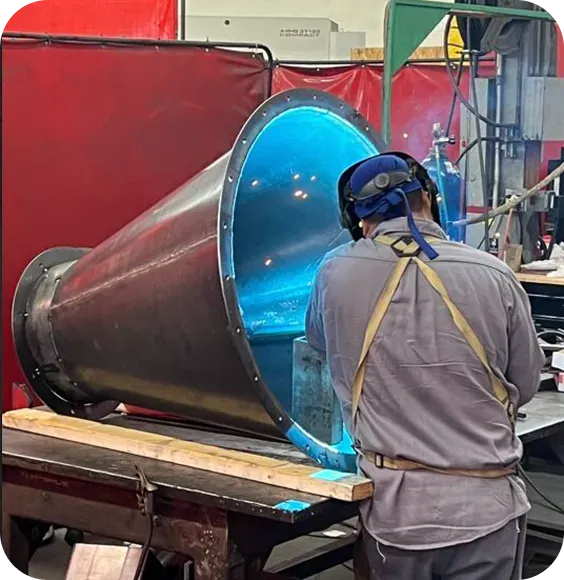
Reduce OEM assembly risk with practical guidance on welding quality, supplier control, RFQs, lead times, and fabrication readiness.
OEM production lines lose stability when welded assemblies arrive late, arrive out of tolerance, or require last-minute fit-up correction. Custom welding and fabrication controls those risks by aligning weld sequencing, fixture strategy, and inspection planning before parts enter the production schedule. The cost of getting it wrong is not only rework; it is idle assembly capacity, supplier expediting pressure, and engineering time diverted from release work.
Mature OEM procurement teams increasingly treat welding and metal fabrication as a production continuity decision rather than a commodity buy. Proper structural integration typically requires early review of load paths, weld access, material behavior, and downstream assembly constraints. Rigorous oversight is what turns an RFQ package into a manufacturable release without hidden assumptions. The strongest partnerships create predictable delivery schedules because technical review, quality planning, and supplier communication happen before production pressure peaks.
People Also Ask
What is the difference between MIG and TIG welding?
MIG welding (GMAW) uses a continuously fed consumable wire electrode, while TIG welding (GTAW) uses a non-consumable tungsten electrode and (when needed) a separately added filler rod. MIG is generally faster and often used for higher-productivity work, while TIG offers finer control and is commonly chosen when precision and weld appearance matter more.
What does MIG mean in welding?
MIG is a common informal term for Gas Metal Arc Welding (GMAW), a process that uses an electric arc and a consumable wire electrode fed through a welding gun. The weld area is protected by shielding gas to help prevent contamination.
Is metal fabrication considered manufacturing?
Metal fabrication is generally the process of creating parts or structures from raw metal through operations such as cutting, bending, and assembling. At the same time, manufacturing is often described more broadly as the production of finished goods (which can include assembling fabricated parts). In practice, fabrication is commonly treated as a subset within the overall manufacturing workflow.
Why Custom Welding and Fabrication Prevents Assembly Delays
Assembly delays usually begin upstream when a weldment looks correct on paper but fails at the fixture, conveyor, or mating interface. Misaligned holes, inconsistent bracket angles, poor distortion control, and unclear datum strategy tend to create rework that spreads across downstream labor planning. Custom welding and fabrication are most valuable when engineering review connects structural tolerances with how the component will be handled, installed, and loaded.
A reliable welding and fabrication company can meaningfully shorten turnaround time because fit-up, fixturing, weld sequence, and inspection expectations are resolved before release. The tradeoff is clear: selecting the lowest piece price may create more schedule exposure than choosing a supplier with stronger manufacturability review. For a deeper breakdown of RFQ readiness, see our guide on supplier documentation and manufacturability review.
How Custom Welding and Fabrication Ensures Consistent Quality
Quality consistency is built during planning, not rescued after welding is complete. Certified technicians, documented procedures, and controlled setup practices keep heat input, joint preparation, and distortion management aligned with the drawing intent. In mature programs, inspection is treated as a production control point rather than an administrative signoff.
Advanced testing verifies joint integrity before assemblies move into final integration. Visual inspection, dimensional checks, fit-up review, and nondestructive examination, where required, give procurement and engineering teams clearer evidence that the weldment is ready for downstream work. The risk factor is escaped variation: small inconsistencies in weld access or alignment tend to become larger quality issues once coating, assembly, or packaging begins.
Standardized inspection protocols are especially valuable across large production volume runs. Welding and metal fabrication quality improve when acceptance criteria, hold points, and documentation requirements are consistent across shifts and suppliers. The practical tradeoff is added planning discipline up front for materially lower defect risk later.
Selecting Custom Welding and Fabrication for Turnkey Manufacturing
Turnkey manufacturing is a control strategy, not a convenience label. Consolidating welding, fabrication, finishing coordination, and assembly support reduces handoff friction, which often leads to unclear ownership when RFQs change or lead times tighten. The best procurement decision is usually the supplier that can provide technical clarification, production planning, and quality documentation without pushing coordination back onto the buyer.
Pen Manufacturing delivers reliable contract manufacturing support for complex projects by aligning consultation, component design review, welding readiness, and fabrication planning under accountable project control. That matters because complex OEM work tends to expose weak communication faster than simple repeat purchasing.
Procurement teams should request detailed consultations before release, especially when drawings include tight-fit requirements, critical weld access, or quality documentation requirements. Custom welding and fabrication should be evaluated on manufacturability insight, scheduling reliability, inspection discipline, and willingness to challenge unclear specifications. Buyers who make that shift reduce avoidable disruption and protect production continuity rather than merely sourcing a welded part. Contact us today!

Director of Operations
Jonathan Nguyen is a supply chain and operations leader with more than 22 years of experience driving procurement, vendor management, international logistics, and operational excellence across diverse industries. Throughout his career, he has developed… Read More