

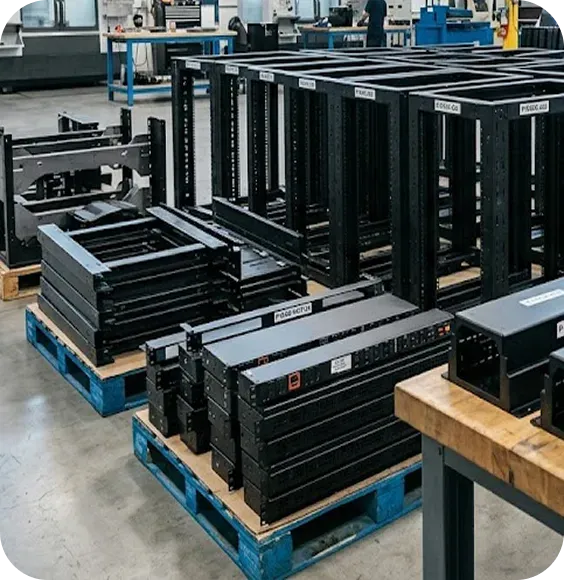
OEM procurement teams evaluating an industrial fabrication service partner need more than a price quote. This guide covers capability and quality.
Procurement teams face significant pressure when selecting reliable manufacturing partners for custom enclosures. A poor vendor choice compounds quickly, creating schedule disruptions, quality escapes, and strained customer relationships that are difficult to recover from. Outsourced production requires active management and a highly capable operations organization to succeed.
Buyers who treat vendor selection as a one-time administrative task rather than a strategic qualification process consistently encounter preventable failures. This guide explores how buyers assess technical competence and overall vendor fit when engaging an industrial fabrication service for complex, high-stakes programs.
People Also Ask
What is contract sheet metal fabrication?
Contract sheet metal fabrication is the outsourcing of metal component and assembly manufacturing to a specialized fabrication company (often called a job shop or fab shop). The contract fabricator provides the equipment, expertise, and capacity to cut, form, weld, finish, and assemble parts designed by the OEM/customer.
How can I evaluate a contract fabricator’s quality without visiting the facility?
You can request recent first-article inspection reports, customer references for similar applications, and proof of quality certifications (such as ISO 9001:2015). It’s also common to review their inspection equipment list and calibration practices to gauge measurement capability and process control.
What information should I provide for a fabrication project quote?
Provide drawings or well-dimensioned sketches, material specifications (type/grade/thickness), quantities (including potential future volume), and timeline expectations. Also include quality requirements such as tolerances, finishing/coating needs, and any required certifications or compliance with standards.
Why Choosing the Right Industrial Fabrication Service Matters
Selecting an inadequate partner often leads to slipped schedules and costly audit failures. Beyond missed delivery windows, the downstream consequences include rework costs, expedite fees, and damaged relationships with end customers. The lowest initial quote frequently hides substantial downstream expenses and unexpected rework delays, particularly when a vendor lacks the process controls to hold tight tolerances at volume.
A dependable industrial fabrication service ensures consistent quality and protects intellectual property through documented handling procedures and controlled access to proprietary designs. Procurement teams that prioritize the total cost of engagement over unit price consistently achieve better program outcomes and lower lifecycle risk.
Core Capabilities of Industrial Metal Fabrication Partners
Top vendors offer comprehensive solutions ranging from precision machining to complex custom enclosures. When evaluating a facility, buyers should assess whether the shop can handle the full scope of a program internally or relies heavily on subcontractors, which introduces quality and schedule risk. Evaluating machine tolerances and cutting capacities ensures the facility handles specific engineering requirements without workarounds that compromise dimensional accuracy.
Robust industrial metal fabrication requires seamless integration between prototyping and high-volume production runs, so buyers should confirm that the same quality systems govern both phases. Facilities that maintain this continuity tend to deliver more predictable results across the product lifecycle.
How to Evaluate an Industrial Fabrication Service Provider
Buyers must verify active quality management certifications before initiating any formal vendor qualification. Certifications such as AS9100D signal that a facility operates under documented, auditable processes rather than informal tribal knowledge. Buyers should confirm that certificates are current, not lapsed, and that the scope of certification covers the specific services being procured. A certificate covering sheet metal fabrication does not automatically extend to welding or finishing operations, so scope verification matters as much as certification status itself.
Assessing a supplier involves reviewing their ability to develop custom testing solutions internally, thereby reducing dependence on external test houses and shortening feedback cycles during production. Facilities with in-house test capability tend to catch dimensional and functional deviations earlier in the production cycle, before nonconformances propagate across a full production run. Buyers should ask directly whether test fixtures and inspection protocols are developed on-site or sourced externally, since the answer reveals how much process control the facility actually owns.
A thorough industrial fabrication service assessment includes matching vendor scale to production volume. A shop optimized for low-volume prototype work may lack the capacity planning discipline required for sustained high-volume delivery. Buyers should request evidence of how the facility manages capacity across concurrent programs, including how scheduling conflicts are resolved during peak demand periods.
Site visits remain the most reliable method for confirming that stated capabilities match actual floor-level practice. A facility tour reveals the condition of equipment, housekeeping standards, workflow organization, and operator engagement, all of which are leading indicators of production consistency. Buyers should treat the site visit as a structured audit rather than a courtesy call, arriving with a defined checklist that covers material handling, in-process inspection, and nonconformance documentation practices.
Advanced Selection Criteria for Industrial Steel Fabricators
Financial stability demonstrated through continuous equipment reinvestment signals a reliable long-term manufacturing partner. Facilities that defer capital investment tend to accumulate capability gaps that surface as quality problems or capacity constraints during peak demand. Procurement teams should avoid industrial steel fabricators that depend heavily on single industries, as concentrated customer bases create scheduling volatility that affects all customers during sector downturns.
Strong employee retention practices within the facility are directly correlated with consistent production quality, as experienced operators carry process knowledge that cannot be fully captured in work instructions. Buyers should request workforce tenure data and training program documentation as part of the formal qualification process.
Next Steps for Securing an Industrial Fabrication Service with Pen Manufacturing
Partnering with Pen Manufacturing provides procurement teams with dependable precision sheet metal solutions built around rigorous quality systems and U.S.-based supply chain reliability. Our advanced technology and rigorous quality systems deliver durable components for complex applications, supporting OEM programs that demand dimensional consistency and on-time delivery across production volumes.
Buyers seeking a reliable industrial fabrication service should request a comprehensive project consultation to align on the scope, tolerances, lead-time requirements, and qualification documentation before committing to a production agreement.

Director of Operations
Jonathan Nguyen is a supply chain and operations leader with more than 22 years of experience driving procurement, vendor management, international logistics, and operational excellence across diverse industries. Throughout his career, he has developed… Read More