

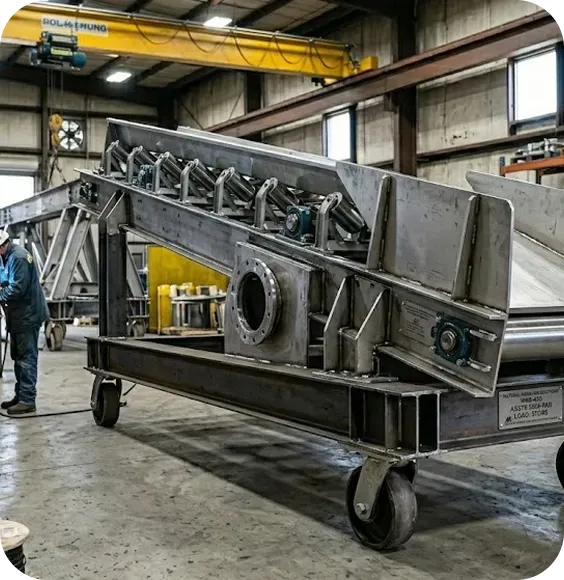
See how engineering support, product development, production planning, quality, fabrication, and delivery come together in productive manufacturing projects.
A successful manufacturing project doesn't start when the first sheet of metal arrives in the shop. It starts a lot earlier, long before any machinery starts working. It begins with clear & accurate drawings, the practical decisions you have to make along the way, and the right kind of engineering support to get things off the ground.
For OEM teams, every stage affects the next. The materials you choose affect how you approach fabrication, which in turn affects how you approach inspection. And what happens in assembly can even force a rethink of the design specs for individual parts.
Similarly, finishing may require some adjustments to tolerances or packaging. On top of that, delivery requirements can dictate exactly how you plan production.
When you plan all these pieces from the start, projects tend to stay on track with far fewer unanswered questions hanging over them. But when you treat them as separate tasks, even small gaps can quickly grow into bigger issues like Request-For-Quote delays, drawing revisions, production hold-ups, or rework.
People Also Ask
What does engineering support mean in manufacturing?
Engineering support helps connect product requirements with practical manufacturing methods. It can include drawing review, manufacturability input, tolerance review, material evaluation, and process planning.
Why is production planning important?
Production planning determines how material, equipment, fabrication, inspection, finishing, assembly, and scheduling work together before production starts.
When should a manufacturer become involved in product development?
Manufacturing input is most useful while the design can still change. Early involvement gives teams more time to correct manufacturability concerns before production.
What Makes a Manufacturing Project Successful?
Successful manufacturing projects start with clear requirements and early communication between engineering, procurement, and manufacturing teams.
Before production begins, the manufacturer should understand the drawings, materials, tolerances, quantities, inspection needs, finishing requirements, assembly details, and delivery expectations.
From there, production planning determines how the work will move through fabrication, machining, inspection, finishing, and assembly. Each stage is part of Pen Manufacturing's metal fabrication services for OEMs.
The goal is to keep every stage aligned with the same design intent.
Start With a Clear Project Definition
Many manufacturing problems start with missing information.
A drawing may be complete but lack the current revision number.
A finish may be mentioned without enough detail.
An RFQ may list a material without identifying the grade.
Quantity expectations may still be unclear.
None of these issues seem major on their own. But together, they can slow quoting and create avoidable questions once planning starts.
A strong project package should usually include:
- Current drawings and revision levels
- CAD files when required
- Material specifications
- Critical dimensions and tolerances
- Expected quantities
- Welding requirements
- Finishing requirements
- Assembly details
- Inspection expectations
- Requested delivery schedule
Not every project needs the same level of documentation. What matters is that everyone involved is working from the same information.
Clear project information also makes the quoting stage easier to manage. Following RFQ best practices for OEM procurement teams can help engineering and procurement teams communicate drawings, quantities, tolerances, finishes, quality requirements, and delivery expectations before planning begins.
Pen Manufacturing starts its manufacturing process with RFQ and project review. Engineering evaluation and material and production planning follow before work moves into fabrication.
Engineering Support Connects Design With the Shop Floor
A drawing explains what the finished part should be. It does not always show the most practical way to make it. That is where engineering support becomes important.
Before production starts, manufacturing teams may review bend locations, hole placement, material thickness, weld access, machining features, tolerances, hardware locations, finishing requirements, and assembly sequence.
The purpose is not to redesign a customer’s product for its own sake. The purpose is to identify issues while there is still time to make a useful change.
Consider a fabricated enclosure with several bent panels and a machined mounting plate.
The drawing may look complete, but a manufacturing review could still raise a few important questions.
Will a nearby hole distort during bending?
Can a welder reach the joint after installing another panel?
Which dimensions control mounting-plate alignment?
Should finishing happen before or after final assembly?
These are practical manufacturing questions. Answering them before production begins is usually far easier than solving them after parts are already in process.
Product Development Works Better With Feedback
Product development rarely moves directly from CAD to finished production without adjustment.
Early builds often reveal details that were difficult to see on a screen.
A part may need more clearance. A mounting point may work better elsewhere. A weld sequence may need to change. A machined feature may be difficult to reach once the assembly is complete.
That feedback should inform the next design decision.
A prototype is most useful when the engineering team treats it as a learning stage rather than simply asking whether the part passed or failed.
Manufacturing requirements often change as a project moves from early parts into repeat production. Understanding how Pen Manufacturing approaches low- and high-volume machining gives OEM teams more context for planning that transition.
Project Example: Plastic Welding Machine
A Pen Manufacturing project shows how that collaboration can develop over time.
Pen Manufacturing initially worked with an engineer from a long-term customer to create a prototype plastic welding station. Once the concept was proven, the project grew into a complete four-station welding machine.
The customer supplied the electrical components. Pen Manufacturing provided design assistance along with machining, welding, fabrication, and assembly.
The important lesson is not just that the prototype worked.
Knowledge gained during the early build stayed connected to the project as it developed into a more complete manufacturing solution.
Production Planning Turns a Drawing Into a Workable Process
Once a design is ready, someone still has to decide how the part will actually move through production.
That is the role of production planning.
It answers questions that drawings alone cannot.
Customers may never see many of these decisions, but they often determine whether production stays on track.
Poor planning usually appears as waiting.
A fabricated part may sit because the next operation is not ready. Material may arrive later than expected. Inspection may uncover a problem only after additional work is already complete.
Good production planning considers the full manufacturing route before work begins.
Material Decisions Affect More Than Purchasing
Material grade, thickness, shape, and condition can influence forming, machining, welding, inspection, and finishing.
For example, specifying stainless steel is only the beginning. The correct grade must still match the application. Aluminum may require different forming or welding considerations. Carbon steel components may need a suitable finishing process based on where and how they will be used.
Therefore, review the material alongside the manufacturing method.
Pen Manufacturing works with materials including aluminum, stainless steel, carbon steel, brass, bronze, and alloy steels across its fabrication and machining work.
The earlier you confirm these requirements, the easier it is to plan the project around the right material.
Fabrication and Machining Cannot Always Be Planned Separately
Many OEM parts pass through several manufacturing operations before they are complete.
A typical project might involve:
- Cutting
- Forming
- Machining
- Welding
- Hardware installation
- Inspection
- Finishing
- Assembly
The order matters.
A machined feature may need to be completed before welding because tooling cannot reach it later. Another assembly may need final machining after welding because critical dimensions depend on the completed structure.
No single sequence works for every project.
Pen Manufacturing provides sheet metal fabrication, CNC machining, welding, assembly, and finishing capabilities. Its manufacturing process connects fabrication and machining with inspection, assembly, finishing, and delivery coordination.
Project Example: Stainless Steel Stonemills
Pen Manufacturing’s Stonemills project shows why process sequence matters.
The work involved stainless steel components. Certain pieces were pre-machined before welding. The completed assemblies were then machined, internal surfaces were polished to a mirror finish, and exterior surfaces were bead blasted to create a uniform finish.
Each stage affected the next.
Machining, welding, final machining, polishing, and finishing could not simply be treated as unrelated tasks.
For complex manufacturing work, the full process route deserves as much attention as the individual operations.
This suggests that keeping more operations connected can also reduce the number of supplier handoffs an OEM must manage. For a broader look at this approach, see how in-house capabilities and forecasting can help build a more resilient manufacturing supply chain.
Quality Planning Starts Before Final Inspection
Quality control should not begin after the part is finished.
Before production starts, the team needs to know what matters most.
Which dimensions affect fit?
Which surfaces need a specific finish?
Are there features that should be checked before welding or assembly makes them difficult to reach?
Which drawing revision should inspection use?
Once those requirements are clear, inspection can be built into the process rather than added at the end.
Pen Manufacturing describes a quality process that begins with front-end engineering preparation. Critical dimensions and quality requirements are identified before fabrication. In-process inspection follows, with final verification using Keyence CMM and calibrated metrology equipment.
Pen Manufacturing also lists AS9100 and ISO 9001 certifications. That does not remove the need for project-specific quality planning. Certifications provide a framework, but drawings and customer requirements still define what to check on each job.
Assembly Can Expose Problems That Individual Parts Do Not
Even if a part checks all the boxes on its drawing, it can still cause issues during assembly.
For instance, two holes might not line up as the team planned. A fastener could be tricky to access. Weld distortion might throw off a mating surface. Plus, a coating can add extra thickness where another part needs breathing room.
Those issues often appear only when several components come together.
Looking at the full assembly during product development helps engineers understand how individual design decisions interact.
This becomes especially important for enclosures, machinery, fabricated structures, and assemblies that combine formed, welded, and machined parts.
Manufacturing teams need to understand more than how each part is made. They also need to understand how the completed pieces will fit and function together.
Finishing Should Be Planned Early
Finishing may happen near the end of production, but the decision should not wait until then.
The selected finish can affect:
- Surface preparation
- Masking
- Corrosion protection
- Dimensional clearance
- Appearance
- Handling
- Assembly order
During final assembly, a coated surface may require extra protection. You might find that certain areas need to be masked off. Plus, keep in mind that the finish can affect how properly the mating components fit together.
Pen Manufacturing lists finishing capabilities that include powder coating, anodizing, e-coating, galvanizing, bead blasting, and passivation.
The right process depends on the material and application. Defining finishing requirements early keeps the project team from revisiting completed parts later.
Revision Control Keeps Production on the Current Design
Changes happen during manufacturing projects.
The real risk comes when different teams work from different design versions.
A revised hole pattern may affect machining. A material change can affect purchasing. A new welded bracket can change assembly. Even a small drawing update may influence inspection.
When a significant revision occurs, teams should confirm:
- Which components are affected
- Whether material has already been ordered
- Whether fabrication has started
- Whether inspection requirements change
- Whether the schedule needs review
- Whether older files are clearly marked as obsolete
A part can be manufactured perfectly and still be wrong if it was built from an outdated drawing.
Good revision control keeps engineering, purchasing, production, and quality aligned.
Communication Matters Most When Plans Change
Manufacturing projects are easy to manage when everything happens exactly as planned.
The real test comes when something changes.
Material may become harder to source. Engineering may revise the drawing. The shop may identify a difficult feature. Order quantities can change. Inspection may uncover something that needs clarification.
These situations require quick communication between engineering, procurement, production, and quality.
A manufacturing partner should raise questions while there is still time to act.
Silence is rarely helpful when a requirement is unclear.
That is why responsive communication and engineering support matter just as much as equipment or production capacity on more involved OEM projects.
Delivery Planning Should Start Before Production Ends
Delivery is the final step, but it can influence decisions much earlier.
A customer may need staggered shipments instead of one complete order. Large assemblies may require special handling. Finished surfaces may need added protection. Delivery may also need to line up with installation crews, another supplier, or an OEM production schedule.
Those details belong in the production plan.
Pen Manufacturing includes delivery coordination as the final stage of its manufacturing process.
Project Example: Angel Stadium
Pen Manufacturing’s work at Angel Stadium shows how the finished installation can influence fabrication decisions.
The company was asked to provide custom steel work for speaker mounts above LED light walls. Pen Manufacturing redesigned the system to simplify installation, fabricated the components, applied the requested green finish, and prepared the project for delivery.
What stands out is the design decision.
The team considered how the fabricated parts would be installed, not just whether they could be manufactured.
That is a useful reminder that successful delivery means more than getting parts out of the building. Consider the final application much earlier.
Where Manufacturing Projects Commonly Lose Time
Design to Delivery Checklist for OEM Teams
Before releasing a project into production, take a final look at the entire process.
Design
Are the latest drawings available?
Are critical dimensions clearly identified?
Has the design been reviewed for manufacturability?
Materials
Is the exact material specified?
Are grade, thickness, and surface requirements clear?
Production Planning
Has the manufacturing sequence been reviewed?
Do machining, forming, welding, and assembly requirements work together?
Quality
Are inspection points defined?
Does the quality team have the current drawing revision?
Are critical features easy to inspect at the right stage?
Finishing and Assembly
Is the finishing process appropriate for the material and application?
Are masking or preparation requirements defined?
Can tools and hardware reach the necessary assembly points?
Delivery
Are quantities and dates confirmed?
Do finished surfaces require protective packaging?
Will the order ship at once or in planned releases?
If you still don't have answers to several of these questions, the project may need more planning before production begins.
Final Thoughts
Successful manufacturing projects rarely result from one machine or one production step.
They come together when design, engineering support, material selection, production planning, fabrication, machining, quality, assembly, finishing, and delivery all stay connected.
For OEM teams, many of the most important decisions happen before production starts. Clear project information and early manufacturing input help everyone understand what comes next.
Pen Manufacturing follows a tested process that begins with RFQ review and engineering evaluation, then moves through material planning, production setup, fabrication, machining, inspection, assembly, finishing, and delivery coordination.
That connection from design through delivery helps keep the manufacturing process focused on the same project requirements from start to finish.

Director of Operations
Jonathan Nguyen is a supply chain and operations leader with more than 22 years of experience driving procurement, vendor management, international logistics, and operational excellence across diverse industries. Throughout his career, he has developed… Read More